Volvo Opens Factories to Geely Group
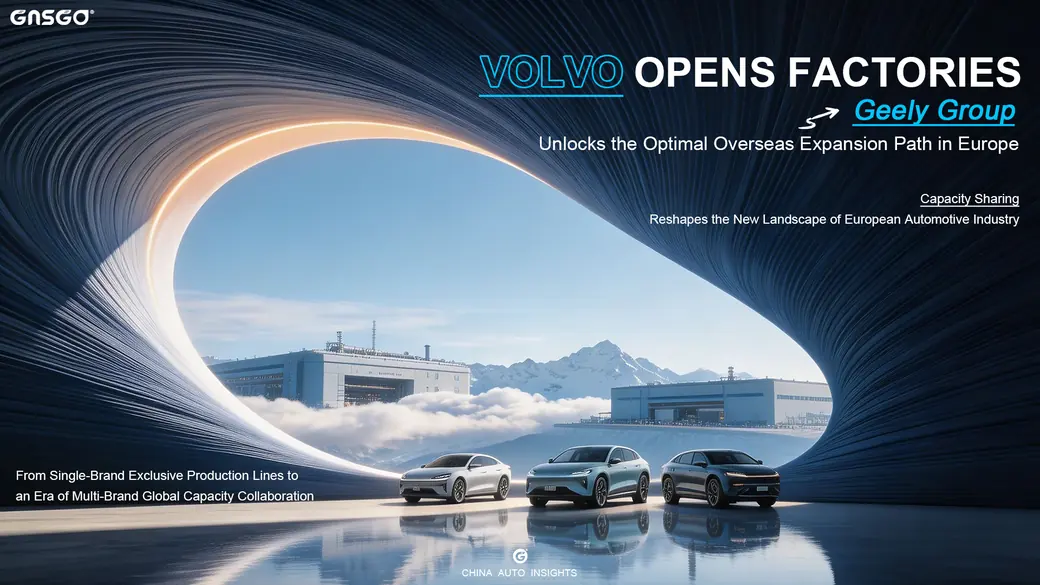
Volvo has 800,000 units of European capacity. Its CEO just invited it to Geely’s Chinese brands. Volvo Cars CEO Håkan Samuelsson said something last week that would have been unthinkable a decade ago.
In a public interview, he invited Geely, Zeekr, and Lynk & Co to use Volvo’s European factories — rather than spending billions building their own. His words were direct: “To succeed in Europe, you must have local production.
Using Volvo’s existing facilities could be a faster, more economical path than building new plants.”Volvo operates two European plants today — Torslanda in Sweden (300,000 annual capacity) and Ghent in Belgium — plus a third under construction in Košice, Slovakia (250,000), scheduled for 2027.
Combined capacity: roughly 800,000 units. Volvo’s 2025 European retail sales: 332,667, down 10% year on year — roughly 42% of that capacity. The Košice plant hasn’t even fired up yet. The fixed costs on idle capacity don’t disappear. For Geely, this is a second door into Europe — and potentially a faster one.
Geely is already pursuing one path: negotiating with Ford to acquire the idled “Body 3” assembly line at Ford’s Almussafes plant in Valencia, Spain. That line has been dormant since 2023.
If the deal closes — estimates put the transaction at €300-500 million, versus €1.5-2 billion for a greenfield plant — Geely would produce a new-energy model under internal code “135” for European markets, targeting Q1 2027. Lynk & Co’s vehicles already run on platforms shared with Volvo — CMA, SPA.
The engineering overlap is real. Retooling a Volvo line to handle Lynk & Co or even Zeekr models is not a theoretical exercise. It’s a weekend shift change with familiar architecture. And the commercial groundwork is already being laid.
On March 30, Geely and Volvo signed a non-binding MoU: Volvo will handle Lynk & Co’s European marketing, sales, and after-sales operations — Germany, France, Spain, Italy among the target markets. Lynk & Co retains product design and homologation. Volvo provides the commercial infrastructure.
For Geely, local production isn’t just a margin play. It’s a compliance prerequisite for sustained European market participation. The traditional model: a European brand owns a European factory, producing European-branded vehicles for European markets.
The emerging model: a European brand owns a European factory, producing vehicles for multiple brands — some European, some Chinese — under the same roof, sharing the same fixed-cost base, serving different market segments.
Sources
- Automobilwoche interview with Volvo Cars CEO Håkan Samuelsson, 19 June 2026, via newmobility.news, 22 June 2026 — Geely’s sister brands could produce at Volvo’s European plants; total capacity with Košice around 800,000 units.
- Volvo Cars, 2025 full-year sales release, 7 January 2026 — Europe retail sales 332,667 (2024: 369,685, −10%); global 710,042.
- Volvo Cars, Košice (Slovakia) plant announcement — designed for up to 250,000 cars per year.
- Volvo Car Gent official plant data — 212,177 cars built in 2025.
- Geely Auto / Volvo Cars MoU on Lynk & Co European distribution, 30 March 2026.