GAC Motor Officially Entered Morocco on July 8
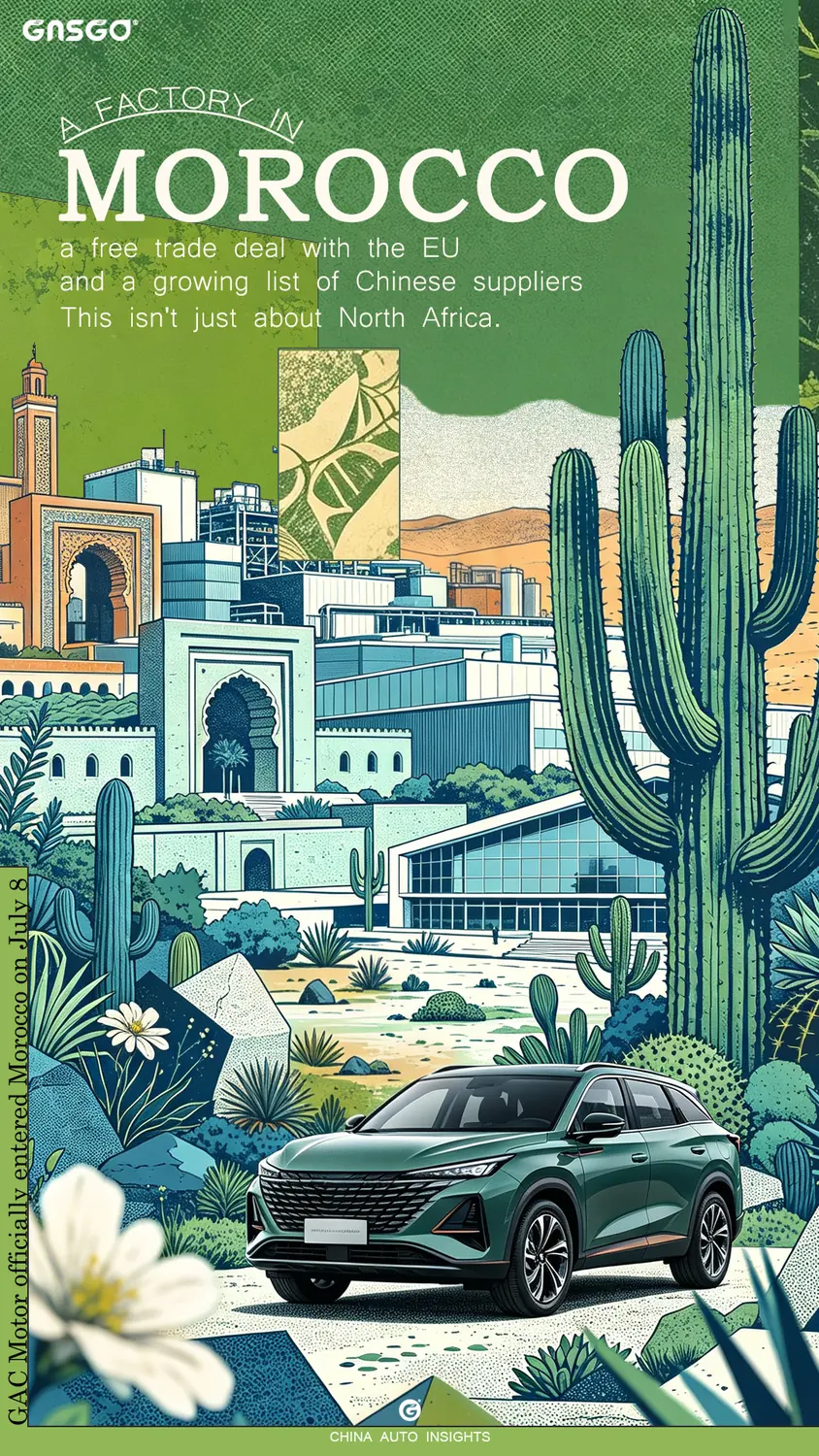
GAC Motor officially entered Morocco on July 8, launching three SUVs in Casablanca with local partner M-AUTOMOTIV. The models: EMZOOM (compact ICE), EMKOO HEV (hybrid), and S7 PHEV (plug-in hybrid). First showrooms are already operational in Casablanca and Tangier.
No full EVs at launch — deliberate calibration for a market where charging infrastructure is still developing and diesel still holds 70% share. Morocco is not just a 235,000-unit auto market that grew 33% last year. It’s a country with free trade agreements covering the EU, the US, Turkey, and much of Africa.
Vehicles produced in Morocco can enter the European Union tariff-free. Stellantis and Renault already operate major production facilities in the country. Morocco is Africa’s largest passenger vehicle producer and exporter. About 90% of its auto output is exported, primarily to Europe. The industrial base is real.
The logistics are proven. The trade lanes are established. Now Chinese automakers are entering — not just with CBU imports, but with local assembly and supply chain investment. BYD was the first mover in EVs. Geely launched its EX2 and EX5 EM-i models in Casablanca.
JAC introduced eight models across passenger, commercial, and new energy segments. XPeng opened its first North African flagship showroom in April. Chery and Changan are building their presence.
Seventeen Chinese brands now compete in Morocco, holding a combined 7.7% market share — small in absolute terms, but growing rapidly. For European sourcing directors and supply chain strategists, the question isn’t whether GAC’s EMKOO HEV will take market share from Peugeot in Rabat.
It’s whether the Morocco-based Chinese automotive supply chain — batteries, electronics, components, and eventually complete vehicles — will become a viable alternative sourcing corridor for the European market itself. Morocco exported roughly 530,000 vehicles in 2025, predominantly to Europe.
GAC’s entry into Morocco isn’t the headline. The headline is what happens when 17 Chinese brands, a growing battery supply chain, a free trade agreement with the EU, and 90% export orientation all occupy the same geography at the same time.