Audi-SAIC Just Formed a Joint R&D Company
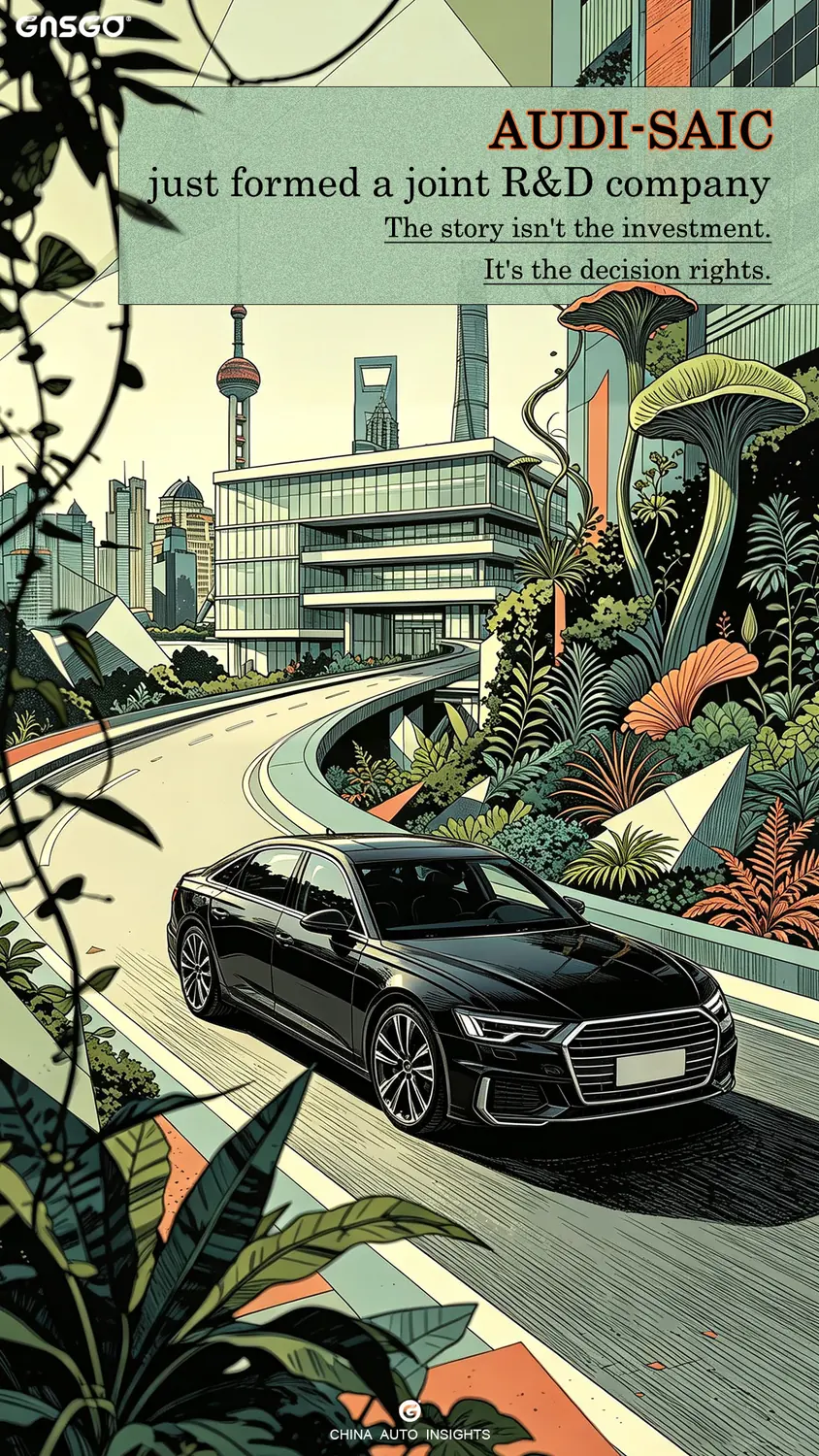
Audi and SAIC just formed a joint R&D company. The story isn’t the investment. It’s the decision rights. Last month, Audi and SAIC announced a new joint venture in Shanghai: the Audi Innovation Technology Center.
It’s an independent legal entity — not a department inside an existing JV, not a cost center reporting to Ingolstadt. A standalone company, with its own management and its own P&L, responsible for vehicle development and product definition for Audi’s China-market EVs.
The traditional model: China team identifies a requirement. Proposal goes to headquarters. Headquarters evaluates, prioritizes against global programs, adjusts scope, sends back. Iteration takes weeks or months. Each cycle adds time, cost, and friction. The China team was an input provider.
The decision sat in Wolfsburg or Munich. Audi’s new center follows the same structural logic. Independent entity. Independent budget. Independent development authority. Same split — R&D in one company, sales in another.
Same rationale — the product cadence demanded by China’s EV market cannot be sustained through a headquarters-centric approval process. What this means structurally. China is transitioning from being the world’s largest automotive market to being one of the industry’s core R&D nodes.
The capability that was built to serve Chinese consumers — rapid iteration, software-driven development, integrated supply chain coordination, cost-efficient engineering — is now being accessed by global automakers for global products.
For European automotive professionals, this shift raises three questions worth tracking:1. If an increasing share of global vehicle development capability resides in China-based teams — regardless of whether they work for Chinese or European brands — what does that mean for the European R&D supply base? 2.
For Chinese automakers going global, the competitive dynamic shifts. The differentiation moves elsewhere — to brand equity, to after-sales infrastructure, to distribution density. Speed becomes table stakes. The brands that understand this shift are already building the organizational architecture to operate in it.
The ones still treating China R&D as a localization function are building teams. The difference between the two is the difference between being fast in China and being fast, period.
Related: MG compatible parts