542 New Models in 5 Months. 3.6 per Day
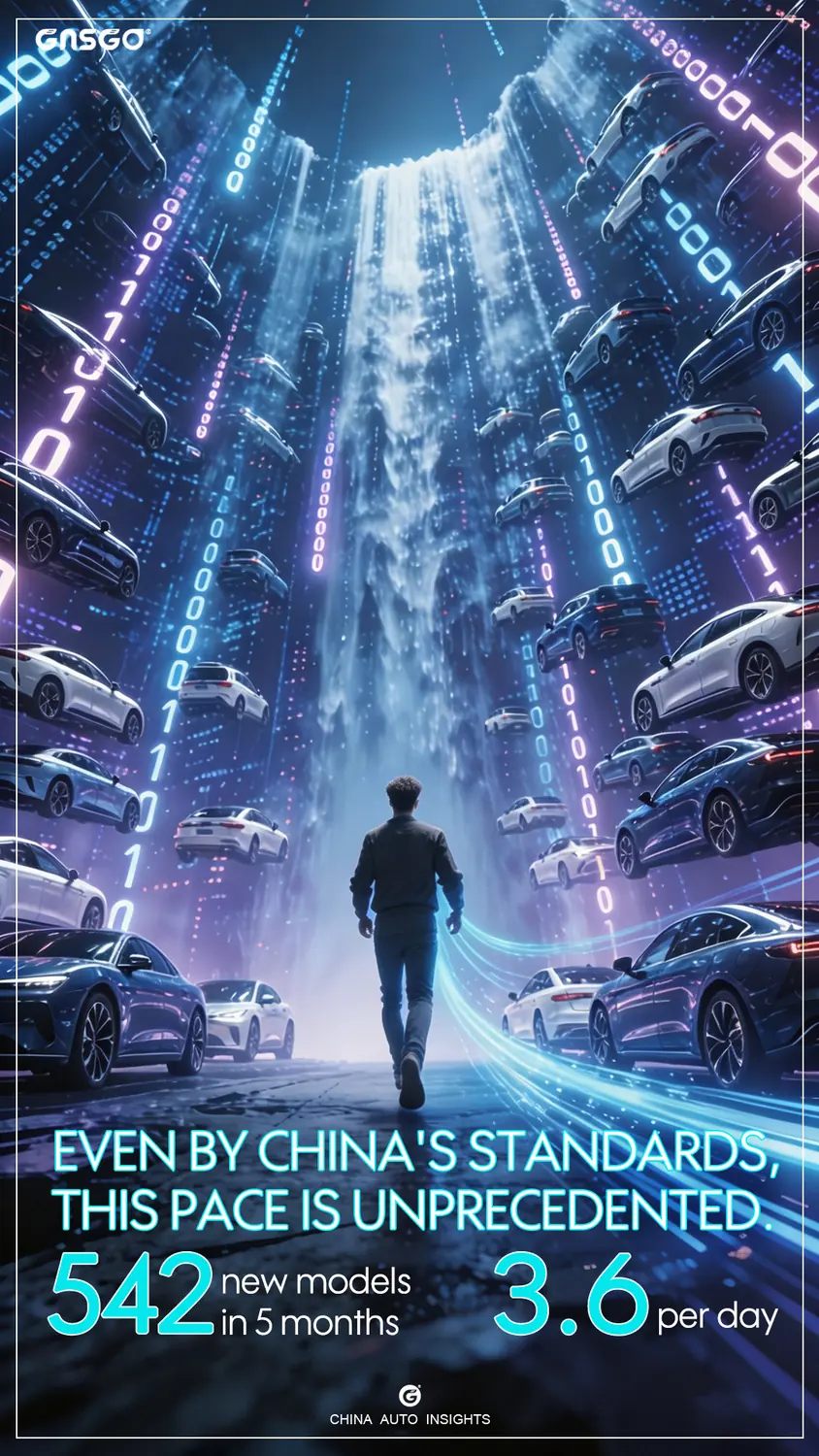
542 new models in 5 months. 3.6 per day. Even by China’s standards, no other market comes close to this pace. China’s passenger vehicle market launched 542 new models between January and May 2026. That’s roughly 108 per month. 3.6 per day.
A Carmaker executive recently made a related observation: Chinese automakers are refreshing products so fast, it’s like they’re making consumer electronics, not cars. The traditional critique — voiced by several European auto leaders — is that this speed implies compromised development rigor.
But there’s another perspective worth considering: competition also breeds strength. The intensity of China’s auto market forces capabilities that are difficult to develop in calmer environments.
Understanding this dynamic matters for anyone tracking the global competitive landscape — not to judge it, but to understand what’s driving it. But even 107 genuinely new or significantly refreshed models in five months is extraordinary by any global standard.
Several Southeast Asian markets don’t see that many new model launches in a year. In a single quarter, China’s market absorbs more product launches than some regions see in a decade. The 3.6-model-per-day pace creates structural effects that go beyond any single brand:Dealer economics are under permanent pressure.
When a model’s competitive window shrinks to months, inventory management becomes existential. A dealer who ordered stock of last quarter’s hot model is sitting on aging inventory by the time the next round of launches hits. Supplier relationships are being rewritten.
A supplier who invested in tooling for a program that runs three years instead of seven sees their amortization window collapse. This forces either higher per-unit pricing or faster tooling amortization — both of which reshape the supply chain economics.
China’s market is operating as a selection environment of extraordinary intensity.
The brands that survive it — that can launch competitive products, manage dealer inventory, hold supplier relationships together, and maintain some semblance of brand coherence while doing it — are building organizational capabilities that are difficult to replicate in calmer markets.
This is the structural logic behind a pattern worth watching: Chinese automakers who survive domestic competition may find global markets less daunting by comparison. Not because the technology is inherently better.
Because the operating metabolism — the speed of decision-making, the supplier coordination, the product refresh cadence — has been conditioned by an environment that punishes slowness more severely than any other major auto market.