Beyond Vehicle Exports: China's Overlooked Parts Engine
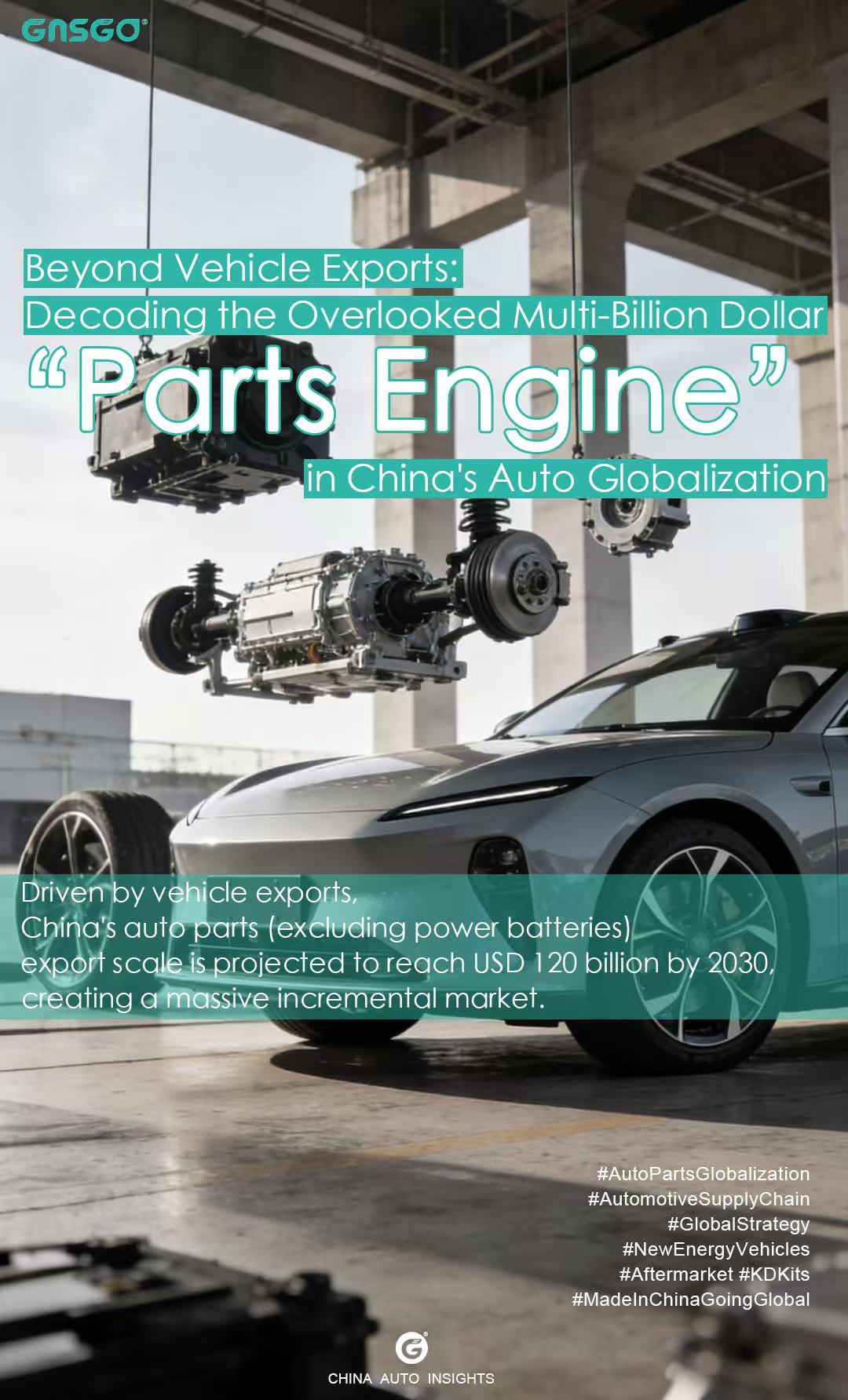
Core Data/Events ● From January to November 2025, China’s vehicle export volume reached 7.331 million units, a year-on-year increase of 25.7%, with the annual figure projected to surpass 8 million units. ● Driven by vehicle exports, China’s auto parts (excluding power batteries) export scale is projected to reach USD 120 billion by 2030, creating a massive incremental market.
In-Depth Analysis The New “Vehicle-Parts” Binding Ecosystem:
China’s auto globalization has evolved from simple trade to an “ecosystem model led by vehicles, supported by parts, and anchored by services.” This creates a stable, ongoing demand chain where every exported vehicle continuously generates parts demand throughout its lifecycle.
Demand manifests in a “Three-Tier Structure”: 1) Aftermarket Rigid demand (maintenance & repair, with higher demand for NEV powertrain systems); 2) Local Assembly (KD Kits) Demand (driving exports of core knocked-down parts to bypass trade barriers and cut costs); 3) Customization & Accessories Demand (value-added products tailored to regional climate, road conditions, and consumer preferences).
Four Strategic Pathways & Capability Reshaping for Parts Globalization:
Path 1: Becoming an “Aftermarket Warehouse” Operator. The core is to follow OEMs’ global footprints, pre-position “overseas warehouses” in key markets (e.g., Middle East, Central Asia, South America), and integrate into leading automakers’ after-sales systems to solve delivery latency issues.
Path 2: Transforming into a “KD Kits Solutions Provider.” This requires “whole-part synergy” capabilities, enabling the supply of certified Complete set of core components (e.g., electric powertrains, smart cockpit modules) for automakers’ overseas assembly projects.
Path 3: Developing “Customization & Accessories” Niche Products. Success hinges on “regional scenario-based R&D” – e.g., heat-resistant parts for the Middle East, cold-weather adaptors for Russia – and leveraging cross-border e-commerce to reach end-users directly with a flexible supply chain.
Path 4: Upgrading to an Integrated “Parts + Service” Supplier. Competitiveness extends beyond products to value-added services like “technical support, financial solutions, and traceability systems,” building stronger customer loyalty and barriers to entry.
Industry Insights ● Capability Building Focuses on “Compliance & Localization”: The key to success is no longer just cost advantage, but rather the ability to swiftly comply with target market regulations (ECE, EPA, etc.) and deeply understand/localize products for specific regional usage scenarios. ● Certification compliance, IP protection, and supply chain financial risks must be integrated into the top-level design of the globalization strategy to avoid significant losses due to regulatory or legal issues.
AutoPartsGlobalization AutomotiveSupplyChain GlobalStrategy NewEnergyVehicles Aftermarket KDKits MadeInChinaGoingGlobal